.svg)
The First 3 Ingredients on Your Soap Label Tell You Everything. Here's the Decoder.
What's Actually in Your Soap? The Ingredient Label Decoded
Most people have a vague suspicion that scientific ingredient names exist to hide something. I was the same way. What I came to learn is that the FDA requires cosmetics and personal care products sold in the US to list ingredients using the International Nomenclature of Cosmetic Ingredients system, known as INCI. This is a standardized global naming system developed by the Personal Care Products Council and adopted internationally. The reason for it is actually legitimate. It ensures that the same ingredient has the same name on every label in every country, which allows consumers, allergists, and regulators to identify ingredients consistently regardless of what common name a brand might prefer to use. Olive oil in English is aceite de oliva in Spanish and huile d'olive in French. Sodium olivate is sodium olivate everywhere.
The irony is that a system designed to increase transparency has, through its technical language, actually decreased it for most consumers who don't know the code. That's what this blog is about. By the end of it, you'll be able to pick up any bar of soap in any store and read it like it was written in plain English.
The INCI system is maintained by the Personal Care Products Council and is recognized not just in the US but across the European Union, Japan, China, and most major markets. Under US regulation 21 CFR 701.3, INCI names are the required labeling standard. Using a common name instead of the INCI name is technically a violation.
The Sodium Name Code
The pattern is simple once you know it. When an oil is saponified, meaning reacted with sodium hydroxide to make soap, it gets a new INCI name following a predictable formula: sodium plus the Latin name of the source oil plus the suffix "ate."
Palm oil becomes Sodium Palmate. Palm kernel oil becomes Sodium Palm Kernelate. Coconut oil becomes Sodium Cocoate. Tallow, which is beef fat, becomes Sodium Tallowate. Olive oil becomes Sodium Olivate. Lard, which is pork fat, becomes Sodium Lardate.
These names aren't hiding what the ingredients are. They're the standardized scientific names for saponified oils and nothing more. What they don't tell you is the quality of the source oil, whether it was organic or conventional, whether the glycerin was retained or removed during manufacturing, or what the formula philosophy behind the product actually is. The name is accurate. The label is incomplete.
Why Most Commercial Bars Aren't Legally Soap
This is where it gets interesting and a little strange.
The FDA's definition of soap under 21 CFR 701.20 requires two things simultaneously. First, the bulk of the non-volatile ingredients must be alkali salts of fatty acids, meaning the cleansing action must come from saponified oils or fats. Second, the product must be labeled, sold, and represented solely as soap with no additional claims such as moisturizing, antibacterial, deodorizing, or beautifying.
If a product meets both criteria it's regulated by the Consumer Product Safety Commission, not the FDA, and technically doesn't need to follow INCI labeling rules, though following them is best practice. Private Oaks bars fall under the Consumer Product Safety Commission because our soap is made from organic saponified oils and is labeled and sold solely as soap. That's it. No drug claims. No cosmetic claims. Just soap.
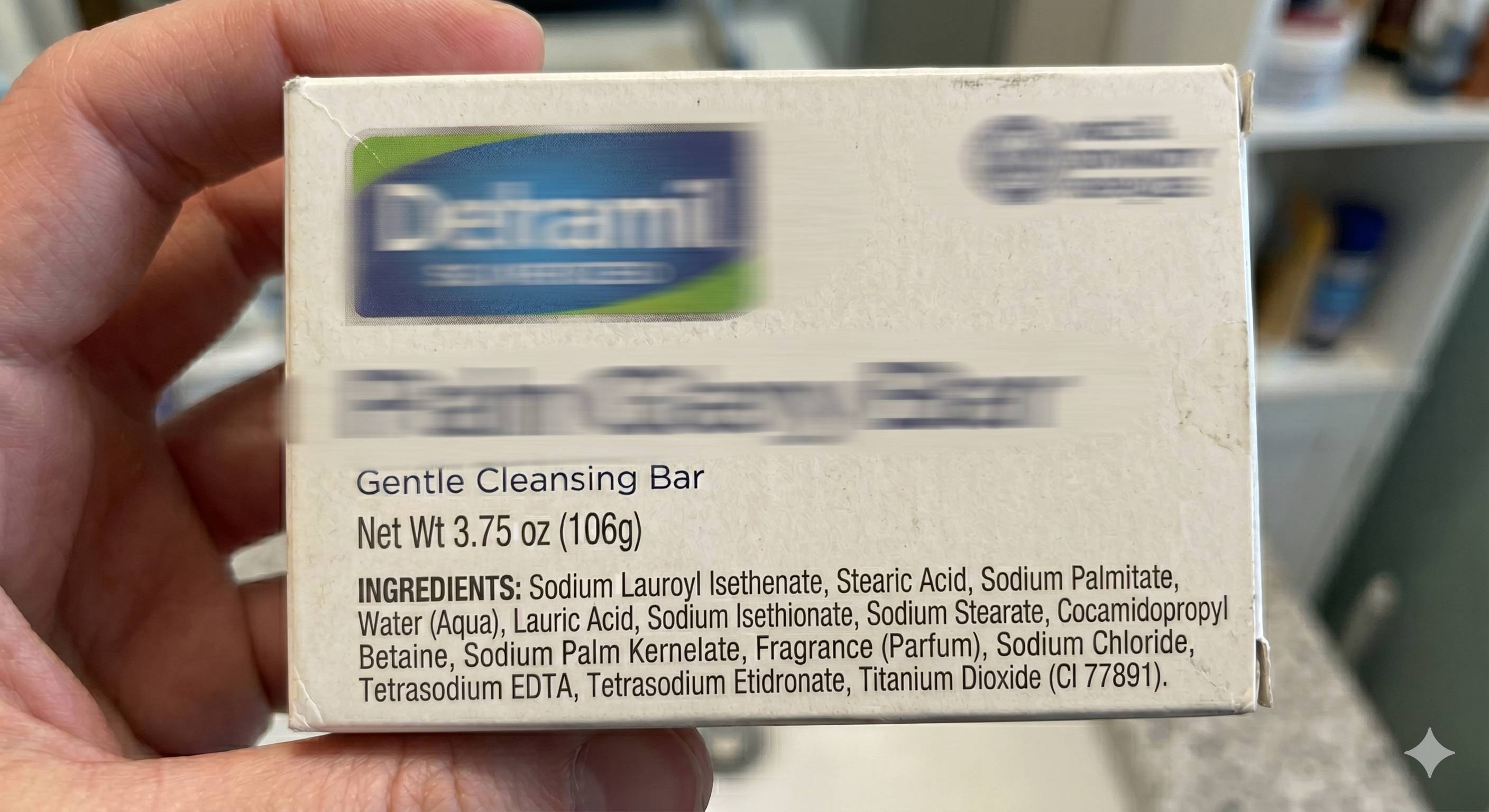
If a product fails either criterion it becomes a cosmetic or a drug under FDA jurisdiction. Synthetic detergent bars that use surfactants like sodium lauroyl isethionate as the primary cleansing agent rather than saponified fatty acids are cosmetics regardless of what they're called on the front of the box. Antibacterial bars with active drug ingredients like benzalkonium chloride are classified as over-the-counter drugs. Bars that claim to moisturize, deodorize, or beautify are cosmetics.
This is why you see "beauty bar," "deodorant bar," "cleansing bar," and "body bar" on commercial products instead of the word soap. The FDA's own labeling guide states explicitly that synthetic detergent bars are considered cosmetics although they may be labeled as soap. These products are legally allowed to call themselves soap on their packaging even though they don't meet the FDA's own definition of the word. This is not illegal. It is simply an inconsistency in how the regulations are written and enforced, and it is one that most consumers have never had reason to think about.
Until now.
The Three-Ingredient Rule
Before we break down individual ingredients, here is the single most useful tool for reading any soap label. The first three ingredients by weight tell you most of what you need to know about any bar's formula philosophy.
If the first ingredient is Sodium Palmate, you're holding a palm oil based bar. If the first ingredient is Sodium Tallowate, you're holding a tallow bar. If the first ingredient is Sodium Lauroyl Isethionate, you're holding a synthetic detergent bar that doesn't meet the FDA's legal definition of soap. If the first ingredient is Sodium Olivate or Sodium Cocoate followed by other saponified plant oils, you're likely holding something closer to a genuinely formulated natural bar.
The glycerin position is also worth checking. If glycerin appears at position three or four on a commercial bar, it was added back in after being extracted during manufacturing, not retained from the original saponification process. If it doesn't appear at all, the bar has no humectant. If it appears very late in the list, it's present in minimal amounts. In a cold process bar made from scratch, glycerin forms naturally and stays in the bar without ever being separated.
Breaking Down Common Ingredients
Here is what the most common ingredients in commercial bars actually are, in plain language.
Sodium Palmate — Saponified palm oil. The backbone of most commercial bars. Hard, shelf-stable, inexpensive, and easy to use in industrial manufacturing. We covered the environmental story behind palm oil cultivation in detail in our oils blog. The ingredient itself isn't the problem. Where it comes from and how it was produced is the conversation worth having.
Sodium Palm Kernelate — Saponified palm kernel oil, which comes from the seed inside the palm fruit rather than the fruit pulp itself. Despite sharing a name, palm oil and palm kernel oil are different ingredients with different fatty acid profiles. Palm kernel oil is higher in lauric acid, similar to coconut oil, and produces bubbly lather and bar hardness. Both come from palm agriculture and carry the same sourcing concerns.
Sodium Palmitate — Saponified form of palmitic acid, a saturated fatty acid found naturally in palm oil, coconut oil, and animal fats. It contributes hardness and a stable creamy lather. It is a true soap component and functions similarly to Sodium Palmate.
Sodium Cocoate — Saponified coconut oil. The lather booster in most formulas. High lauric acid content produces big fluffy foam and strong cleansing. Can be drying when used at high percentages without adequate superfatting to compensate.
Sodium Tallowate — Saponified beef tallow. When you see this on a label it means the bar contains rendered cattle fat. This is the ingredient that immediately tells you the bar is not vegan, and it connects directly to the tallow quality and sourcing conversation we covered in our tallow blog.
Glycerin — When listed as a separate ingredient on a commercial bar, this glycerin was added back after being extracted during manufacturing. In cold process soap making, glycerin forms naturally during saponification and remains in the bar. Commercial manufacturers remove it because glycerin commands a higher price as a standalone commodity ingredient used in lotions, cosmetics, and food products. What gets added back to some commercial bars is a smaller, measured amount of purchased glycerin, not the full complement that naturally forms. We explained this process in detail in our first blog.
Fragrance or Parfum — The single word that hides the most on any ingredient label. Fragrance is a legally protected trade secret in the US, meaning manufacturers are not required to disclose which specific chemical compounds make up their blend. A single fragrance listing can represent dozens of individual compounds. Some bars list individual fragrance allergens like linalool, coumarin, eugenol, citronellol, and hexyl cinnamal separately. This is not because US law requires it but because European cosmetic regulations mandate individual disclosure of 26 known allergens above certain concentrations. If a bar lists these individually it is likely formulated to meet European standards as well. If it only says fragrance you have no way of knowing what specific compounds are present. At Private Oaks our fragrance oils are a blend of naturally derived and lab-created aroma-safe compounds. They are phthalate-free, paraben-free, and free of heavy metals, and we maintain full SDS documentation for every fragrance we use so the information is available if you want it.
Sodium Chloride — Table salt. Used as a texture agent and to control bar hardness during the manufacturing process. Not a skin concern.
Sodium Lauroyl Isethionate — A synthetic surfactant and the primary cleansing agent in many bars marketed as gentle or sensitive. When this appears as the first ingredient the bar is a cosmetic under FDA jurisdiction rather than true soap regardless of what the front of the packaging says. It is milder than SLS and genuinely less stripping for most skin types but it is synthetic and not derived from saponified oils.
Sodium Isethionate — A secondary synthetic surfactant that works alongside sodium lauroyl isethionate. Also synthetic and also a signal that the bar's cleansing action comes primarily from detergent chemistry rather than saponified fats.
Stearic Acid — A naturally occurring fatty acid used as a hardening agent and texture improver. Found naturally in shea butter and other plant and animal fats. Generally mild and skin compatible.
Lauric Acid — The primary fatty acid in coconut oil, used here as a foam booster. Mild at the concentrations typically found in commercial bars.
Cocamidopropyl Betaine — A mild secondary surfactant derived from coconut oil. Widely used in gentle cleansing formulations.
Sodium Stearate — The saponified form of stearic acid. A true soap component. When you see this alongside synthetic surfactants you are looking at a hybrid formula that contains some true soap but relies primarily on synthetic detergent chemistry for its cleansing action. These hybrid bars occupy a gray zone in the FDA's soap definition, which is why they are typically labeled as cleansing bars rather than soap.
Tetrasodium EDTA and Tetrasodium Etidronate — Both are synthetic chelating agents that bind to metal ions in the formula and in hard water, preventing them from interfering with the soap's performance. They extend shelf life and improve lather consistency. Tetrasodium EDTA is synthesized using formaldehyde and sodium cyanide as precursor chemicals. The final compound is not a carcinogen and is considered low risk by the FDA and the Cosmetic Ingredient Review panel at current use levels. It is not present in cold process soap because cold process soap doesn't need a synthetic stabilizer. The environmental persistence of EDTA in water systems has raised documented concerns among environmental researchers. The honest assessment is low individual risk with legitimate questions at scale.
Titanium Dioxide — A mineral whitening agent that gives commercial bars their uniform bright white appearance. The same compound is used in mineral sunscreens. Generally considered safe for topical use in its current particle form.
Synthetic Colorants — Blue 1, Yellow 5, Green 3, Red 4, and similar designations are all petroleum-derived synthetic dyes. They provide no skin benefit and are present purely for visual marketing appeal. The FDA requires them to be listed by color index numbers, which is why you see them as color names and numbers rather than chemical names.
Sorbitol — A sugar alcohol used as a humectant and to improve bar texture. Generally considered safe and mild.
Benzalkonium Chloride — Listed as an active drug ingredient in antibacterial bars, which is why those bars are classified as over-the-counter drugs rather than soap or cosmetics. This is a quaternary ammonium compound that functions as a broad-spectrum antimicrobial. In 2017 the FDA banned 19 antibacterial active ingredients from consumer soap products including triclosan and triclocarban, citing lack of proven benefit over plain soap and water and long-term safety concerns. Benzalkonium chloride was not banned but was placed under mandatory review requiring manufacturers to submit new safety and efficacy data. As of 2024 independent organizations including the Green Science Policy Institute are still urging the FDA to complete that ruling, citing documented links between quaternary ammonium compounds and reproductive, respiratory, skin, and neurological harms. The FDA's own position, established in 2017 and unchanged since, is that antibacterial soap has not been shown to be more effective than plain soap and water at reducing illness or infection.
The Beneficial Ingredients Worth Acknowledging
Not everything on a commercial bar label is cause for concern. Several common ingredients are genuinely beneficial and worth knowing by their INCI names.
Linum Usitatissimum Seed Oil is the INCI name for flaxseed oil. Rich in omega-3 fatty acids with documented skin conditioning properties.
Aloe Barbadensis Leaf Juice is the INCI name for aloe vera. A well-documented soothing and anti-inflammatory ingredient with centuries of use supporting its skin benefits.
Avena Sativa Kernel Meal is the INCI name for oat kernel meal. Colloidal oat is one of the most thoroughly studied skin soothing ingredients available, with an FDA monograph supporting its use as a skin protectant. Particularly beneficial for eczema and sensitive skin, which is why it appears in some of the more thoughtfully formulated commercial bars.
Mentha Piperita Oil is peppermint essential oil. A genuine botanical ingredient with cooling and antimicrobial properties.
Rosmarinus Officinalis Leaf Extract is rosemary leaf extract. A natural antioxidant preservative with documented antimicrobial properties. Its presence in a formula is a signal that the maker is attempting to use natural preservation rather than purely synthetic options.
Kaolin is kaolin clay. We covered what kaolin does for skin in detail in our clays and salts blog. Seeing it on a commercial bar label is a genuine positive worth noting.
The And/Or Designation — What It Means and Why It Matters
Some commercial bars list their base oils using an and/or designation, for example Sodium Palmate and/or Sodium Cocoate, or Sodium Tallowate and/or Sodium Palmate. This is an industry practice that deserves more attention than it gets.
The and/or designation means the manufacturer reserves the right to use either ingredient, or both, depending on whatever is most cost-effective or available at the time of any given production run. It is a supply chain flexibility tool. The formula may shift between production batches without any change to the label or any notification to the consumer.
What this means practically is that a consumer cannot know with certainty which specific base oils are in the bar they purchased on any given day. If you have a sensitivity to tallow and a bar lists Sodium Tallowate and/or Sodium Palmate, you have no guarantee which one is in the bar in your hand.
This is worth understanding not as a criticism of any specific company but as context for why a fixed formula with publicly disclosed ingredients means something. At Private Oaks, what's on our label is what's in every bar, every batch, every time. That's not a marketing claim. It's just how we operate. If you have eczema or sensitive skin and want to understand which of our ingredients matter most for your skin type, our eczema blog goes into detail on exactly that.
One thing worth being upfront about as we close this out. As Private Oaks grows and we develop new products beyond our soap bars, those future products will carry the same INCI scientific names we just decoded. That's not us being hypocritical. That's us following the same FDA cosmetic labeling requirements we just explained. Our future products will be cosmetics under FDA jurisdiction, which means INCI names are required by law under 21 CFR 701.3. What will be different is that every ingredient on those labels will be chosen with the same intentionality we've applied to our soap bars, sourced as cleanly as possible, and documented transparently on our ingredients page the same way our soap ingredients are today. The names will look scientific. The philosophy behind them will be exactly the same.
I spent years buying soap the same way most people do. I grabbed what was familiar, what was on sale, or what smelled good. I never read the label because I didn't know how. Writing this blog is the version of me I wish I'd had access to ten years ago standing in that store aisle.
You now have it. Use it however you choose.
If you want to see what we put in our bars and why, our ingredients page has every ingredient documented transparently.
A double board certified dermatologist covers the clinical side of why gentle non-stripping cleansers matter for skin health in our dermatologist blog.